

Showing posts with label Pharma. Show all posts
Showing posts with label Pharma. Show all posts
Wednesday, April 4, 2012
Clinical Practice Research Datalink is finally here - or is it?
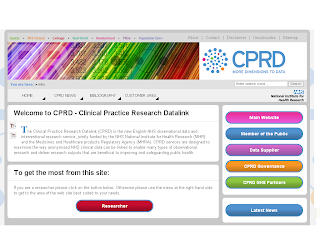
The new Clinical Practice Research Datalink about which we have blogged much in the past has finally arrived (http://www.cprd.com/intro.asp) amid a certain amount of fanfare - see this from Pharma Times, this from PMLive and this from GP magazine.
You may notice that the GPRD pages now redirect to this site and to a certain extent, this is largely a rebranding exercise at the moment. Behind the scenes a team at the DoH are trying to ensure that major data sources are willing and able to engage with this initiative but the speed at which they come online remains to be seen. We'll fill you in further on plans for a researchers data-catalogue interface as this project advances - and if CPRD are not offering that just yet, perhaps the MRC are - we'll get you up to date with the MRC's Data Support Service before the week is out.


Monday, January 30, 2012
Data sharing in research - cultural and technical barriers in Life Sciences and Public Health - Part 2 - Barriers
The second section of our review of attitudes to data sharing in Life Sciences and Public Health was due to look at policies introduced by research funders to oblige researchers to make their data accessible to the community, however, there is more to be said on this than we have currently committed to bytes or paper.
Thus we'll jump ahead here to our section on barriers to data-sharing and aim to get the section on funders' policies to you within the week...
Just a reminder that it's meant to serve as a 'primer' aggregating analyses from the last few years in this area and pointing you to the original articles and as such references other publications pretty heavily - so do check out the footnotes if you want to explore further.
Thus we'll jump ahead here to our section on barriers to data-sharing and aim to get the section on funders' policies to you within the week...
Just a reminder that it's meant to serve as a 'primer' aggregating analyses from the last few years in this area and pointing you to the original articles and as such references other publications pretty heavily - so do check out the footnotes if you want to explore further.
Barriers – incentives and expertise
Discussions of this subject highlight the
lack of active incentives (rather than obligations) to share data: “the lack of
explicit career rewards, and in particular the perceived failure of the
Research Assessment Exercise (RAE) explicitly to recognise and reward the
creating and sharing of datasets – as distinct from the publication of papers -
are major disincentives.”[1]
As mentioned above when looking at Social and
Public Health Sciences the Research Intelligence Network found “found scant
evidence of researchers wanting to publish datasets. Typically researchers will
request data from one or more publicly-available datasets and they will
undertake analysis. Often this process leads to the creation of new, derived
datasets but these tend not to find their way to the public domain.”[2]
Lack of incentive is blamed for this outcome:
“Unlike in some of the other areas we have looked at there are no obvious
rewards that accrue to researchers who decide to make their datasets
publicly-available – though few deny that sharing datasets produced with public
funds is a worthwhile principle….. researchers producing small scale datasets
see no reason to invest the time and effort required to make their datasets
publicly available. Besides which, some
want to control their data, limit the possibility of the data being
misrepresented, and limit the scope for competition [our italics].” [3]
“Other disincentives include lack of time and
resources; lack of experience and expertise in data management and in matters
such as the provision of good metadata; legal and ethical constraints; lack of
an appropriate archive service; and fear of exploitation or inappropriate use
of the data….. Relatively few researchers have the expertise, resources and
inclination to perform themselves all the tasks necessary to make their data
not only available, but readily accessible and usable by others.”[4] Many researchers lack the
skills to meet the quality standards imposed by data centres without substantial
help from specialists.
Additionally, “creating longitudinal datasets
is an expensive business and therefore the people responsible for them tend to
feel the need to protect them. This is manifested in reported anxiety about
commercial organisations using data, deriving slightly or materially different
datasets and claiming intellectual property rights over these new datasets.”[5]
Across the biomedical sciences directors and
PIs see their restricted data as their intellectual capital: “As with most areas of research, there is
competition between researchers to produce the best work in the best journal… Many
researchers wish to retain exclusive use of the data they have created until
they have extracted all the publication value they can.”[6]
From the perspective of commercial / industry
groups data sharing presents many of the same challenges: Intellectual
Property and Confidentiality are particularly sensitive issues. In the past big
pharmaceuticals organisations have traditionally been conservative over data
sharing – concerns include loss of control, cost, other units reaching
different conclusions or deriving novel insights which may have commercial
value.
Within this
field there exists a significant heterogeneity of needs. The complexity and
diversity of the biomedical research landscape breeds diversity in tools and
methodologies for data capture
and analysis, storage, maintenance and curation and this too may fuel confusion
and dampen enthusiasm.
[1] To Share or not to Share: Publication and Quality Assurance of Research
Data Outputs -
[2] Ibid.
[3] Ibid.
[4] Ibid.
[5] Ibid.
Monday, January 16, 2012
UKCRC Funders' vision for Human Tissue Resources - STRATUM project
We had an interesting 'phone conversation today with the head of the STRATUM project and one of the project's workstream leads discussing what promises to be a valuable and long-necessary piece of work looking at the creation of a centralised biobanking data repository for the UK.
Funded in part by the Technology Strategy Board, it will be a public-private partnership. STRATUM (Strategic Tissue Repository Alliance Through Unified Methodology) aims to maximise the value of stored human tissue by creating the foundations of a UK biobanking network. The project will run from October 2011 for 18 months. The partners in the project at present are:
From Pharma: AstraZeneca UK Ltd (lead), GlaxoSmithKline, Lab21 Ltd
From Pharma: AstraZeneca UK Ltd (lead), GlaxoSmithKline, Lab21 Ltd
From Academia: University of Manchester, University of Nottingham, University of Leicester
There's not a great deal out there on the web at present about the initiative but check out the UK Clinical Research Collaboration's notes on the workstreams involved.
Thursday, September 29, 2011
Europe ‘punches above its weight’ in biomedical research, despite limited funding
The text below is the European Science Foundation's (ESF) Press Release promoting a new paper on the status of biomedical research in Europe - the links we have inserted take you to the ESF publications page - this report is (at the time of writing) the top-most in the list of PDF documents. Of interest, and not really mentioned in the release, is the fact that the report also contains sections on the United States and Canada - though we were surprised to see that there appears to be little coverage of research conducted outside of Europe and North America:
The European Science Foundation’s EMRC publishes new White Paper assessing the current status of biomedical research in Europe in a global context.
The European Science Foundation’s EMRC publishes new White Paper assessing the current status of biomedical research in Europe in a global context.
European biomedical research is advancing at a great pace compared to the relatively small funds available, and with more funding, it could do better. This is one of the main conclusions from a new White Paper, published by the European Medical Research Councils (EMRC) – the European Science Foundation’s membership organisation for all medical research councils in Europe.
The EMRC White Paper, entitled ‘A Stronger Biomedical Research for a Better European Future’, will be launched at a meeting held in Strasbourg on 29 September 2011 and follows a previous White Paper, “Present Status and Future Strategy for Medical Research In Europe” published four years ago.
Calling for global collaboration and cohesion in biomedical research, the White Paper analyses the current state of biomedical research within Europe compared with its international collaborators, together with an assessment of new challenges faced in Europe, including changing patterns of diseases, ageing populations and growing cost of healthcare.
Professor Liselotte Højgaard, Chair of the European Medical Research Councils said, “We believe that this White Paper presents a powerful case for the future strategy of biomedical research in Europe, which will benefit society in many ways and will improve the quality of life for the citizens of Europe and the rest of the world and meet the difficult challenges we are facing”.
The White Paper makes five key recommendations which should underlie future policy and strategy for biomedical research in Europe:
1. Citizens and patients should be closely engaged with biomedical research
2. The results of biomedical research should be rapidly and efficiently brought to the patient
3. Biomedical research should be conducted with high quality in an open, honest and transparent way
4. European biomedical research should be conducted within a global context
5. Investment should be increased to create the right world-class biomedical research
Author, Dr. Thierry Damerval, Deputy Director of Inserm (France), said: "With investment in biomedical research yielding a return of 40% per year, adequate funding and best practice for biomedical research are not only essential to secure health and welfare in Europe and the rest of the world, but they also makes sound economic sense”.
The White Paper presents a thorough examination of the present status of biomedical research in Europe and the rest of the world. It is available to view online here.
Thursday, August 25, 2011
Industry and academic reports - New page
We're getting there - 15 documents so far - suggestions welcome!
These are the better known documents from a trawl covering the spectrum of web-pages, journal articles and major reports – these include several reports from the Academy of Medical Sciences, DoH white papers, reports from or commissioned by the Research councils, strategic plans from funders of research in the UK, the Health Survey for England, reviews on data sharing, reviews of patient and professional perspectives on the use of personal information in medical research and statements regarding the economic importance of biomedical research from both government ministries and independent commentators.
We already have a few more lined up to go on today - let us know your views - see the new page above Useful Industry Reports.
These are the better known documents from a trawl covering the spectrum of web-pages, journal articles and major reports – these include several reports from the Academy of Medical Sciences, DoH white papers, reports from or commissioned by the Research councils, strategic plans from funders of research in the UK, the Health Survey for England, reviews on data sharing, reviews of patient and professional perspectives on the use of personal information in medical research and statements regarding the economic importance of biomedical research from both government ministries and independent commentators.
We already have a few more lined up to go on today - let us know your views - see the new page above Useful Industry Reports.
Wednesday, August 24, 2011
Industry and academic reports - New page
During the course of the day we will be adding (and potentially cutting down the descriptive text as the list grows!) a list of academic, industry and government reports of relevance to those working in biomedical research.
Many of these have been referenced in our soon to be published environmental scan of biomedical research in the UK.
They can be found on our new page 'Useful industry reports' above - please let us know of any others you suggest would be of value to our readers.
Many of these have been referenced in our soon to be published environmental scan of biomedical research in the UK.
They can be found on our new page 'Useful industry reports' above - please let us know of any others you suggest would be of value to our readers.
Subscribe to:
Posts (Atom)